
You can be talented, committed, and serious about your music and still struggle to get booked.
That is one of the biggest frustrations in the electronic music scene. Not because artists lack potential, but because they often lack the right way to present themselves.
For years, the industry has relied on EPKs, short for Electronic Press Kits. Usually these are documents, PDFs, drive folders, or messy link collections that artists send to promoters and organisers in the hope of being noticed.
The problem is that this approach is outdated.
Today, artists need something more dynamic, more professional, and more connected to how bookings actually happen.
That is where your Gigevate profile comes in.
Instead of creating a static document that gets lost in inboxes, your Gigevate profile can act as your modern EPK. It gives you a central place to showcase who you are, what you sound like, and why you should be booked.
A DJ EPK is a professional presentation of you as an artist.
It is meant to help organisers, promoters, venues, and collaborators quickly understand your identity, your sound, and your value.
Traditionally, a DJ EPK includes:
In theory, that sounds simple.
In practice, most EPKs are fragmented, outdated, or too generic to make an impact.
The traditional EPK was built for an older version of the music industry.
Today, the booking process moves quickly. Promoters do not want to dig through attachments, broken links, or multiple platforms just to understand whether an artist is relevant for an event.
Common problems with traditional EPKs include:
In other words, the issue is not just having an EPK. The issue is having one that actually works in the real world
A modern EPK should do more than introduce you.
It should help you get discovered, make a strong first impression, and support actual booking decisions.
That means it should:
This is why a profile-based system makes far more sense than a disconnected document.
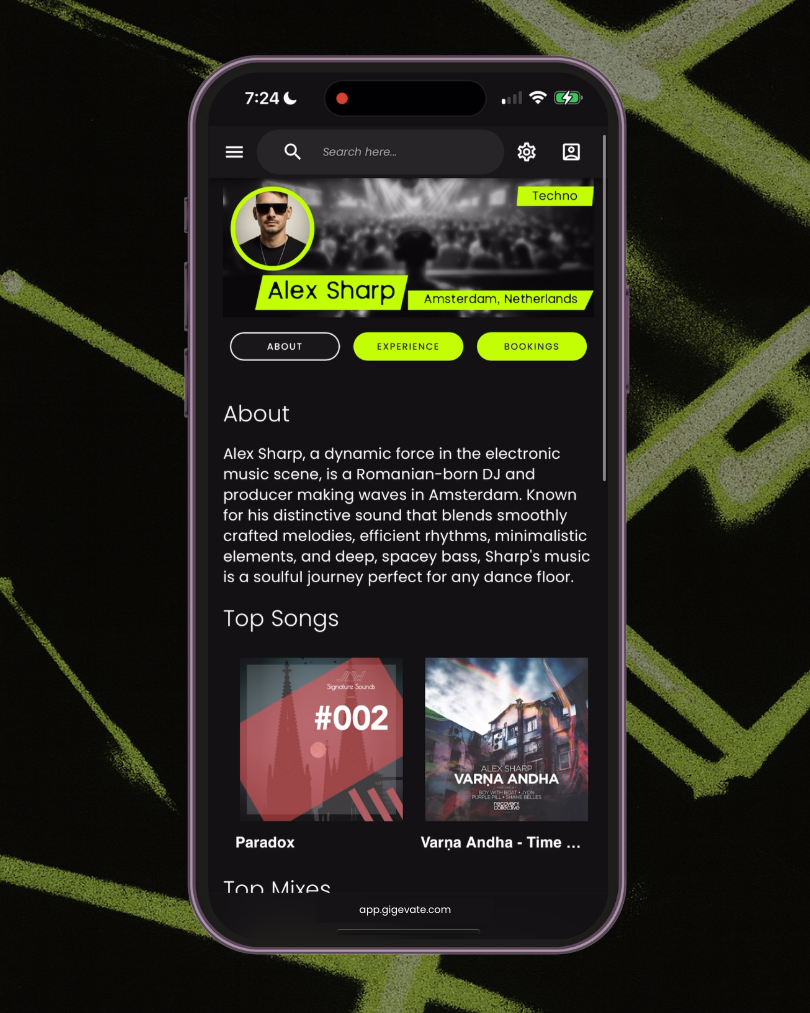
Your Gigevate profile can function as your EPK, but in a way that is more relevant to the electronic music industry today.
Instead of building a separate document, your profile becomes your living professional presence.
It can help you:
This is the key shift.
Your EPK should not just be something you send. It should be something that works for you continuously.
That is what makes a Gigevate profile more powerful than a static PDF.
If you want your Gigevate profile to act as your EPK, it needs to be built strategically.
Your bio should explain who you are in a clear and memorable way.
It should include:
Avoid vague phrases. Be specific.
Your best music should be easy to find.
Include your strongest and most relevant links so that organisers can immediately understand your sound.
Visual presentation matters.
Use imagery that reflects your brand, your energy, and the kind of events you want to be booked for.
Show where you have played, what kind of environments suit your sound, and any past highlights that add credibility.
The difference between a document and a platform profile is that a profile can support next steps.
That matters. Discovery without action leads nowhere.
Most organisers are not looking for the longest story or the most overdesigned press kit.
They want clarity. They want to know:
A well-built Gigevate profile can help answer those questions faster than a traditional EPK ever could.
if you want your Gigevate profile to work as your EPK, avoid these common mistakes:
Your profile is not just information. It is positioning.
This is the real shift artists need to understand.
The old model was:
Create an EPK
Send it around
Hope someone replies
The better model is:
Build a strong profile
Increase your visibility
Make discovery easier
Create a better path to bookings
This is more aligned with how artists should grow today.
The electronic music industry has long relied on informal systems, scattered communication, and inconsistent ways of finding talent.
That makes it harder for great artists to be seen and harder for organisers to make confident decisions.
A stronger profile-based approach helps bring more professionalism, more visibility, and more structure into the scene.
And that benefits everyone.
f you are still thinking of your EPK as a separate document, it may be time to rethink it.
A modern artist needs more than a PDF or folder of links.
You need a profile that represents you properly, supports your visibility, and helps create real booking opportunities.
That is why your Gigevate profile should not just support your EPK.
It should be your EPK.